


What Is Grab Adhesive Used For?
Heading
Grab adhesives are widely used by contractors and DIYers thanks to their strength, ease of use, and ability to work on a wide range of materials.
Ever tried hanging something, only to realise you need to drill, screw, or hammer your way through the job? Grab adhesives are an easier, cleaner alternative that help you avoid the mess and get the job done fast.
They create a quick, strong bond, perfect for tasks like fixing skirting boards or wall panels, and eliminate the need for visible fixings. In this article, we outline how grab adhesives work, explore their best applications, and troubleshoot common problems that may arise.
How Grab Adhesives Work
Grab adhesive is a strong, versatile glue that creates a quick “grab” when bonding materials. It cures into a strong, flexible bond and leaves a professional finish.
Grab adhesives are known for bonding various porous and non-porous materials, such as glass, concrete, metal, wood, brick, stone, ceramic, rubber, and certain types of plastic.
Many grab adhesives offer high initial tack, making them suitable for holding building materials without support*. In addition, they are gap-filling, meaning they can fill and bond uneven surfaces or small gaps.
Note: Performance may vary depending on surface preparation, material type, and adhesive formulation, so it’s important to test suitability before full application.
*Heavy items may require temporary support and mechanical fastening.
Best Applications for Grab Adhesives
Grab adhesives are widely used by contractors and DIYers thanks to their strength, ease of use, and ability to work on a wide range of materials and suitability for interior and exterior use.
Home Improvement or Repairs:
- Attaching trim and mouldings: Bond skirting boards, dado rails, and architraves without mechanical fastenings — provided the adhesive used meets load and safety requirements for that application.
- Interior fittings: Attach trims, shelves, light fixtures, and other lightweight items without drilling.
- Tile installation or replacement: Install tiles on floors or walls without the messiness of grout. Always ensure the adhesive is suitable for the tile type and load-bearing requirements, especially for floor tiles or wet environments.
DIY Projects:
- Furniture repairs: Build or repair furniture quickly and easily.
- Outdoor decorations: Attach decorative elements to pots or planters or create garden edging.
Choosing the Best Grab Adhesive
To make things even easier, here’s a quick reference guide to help you choose the right grab adhesive.
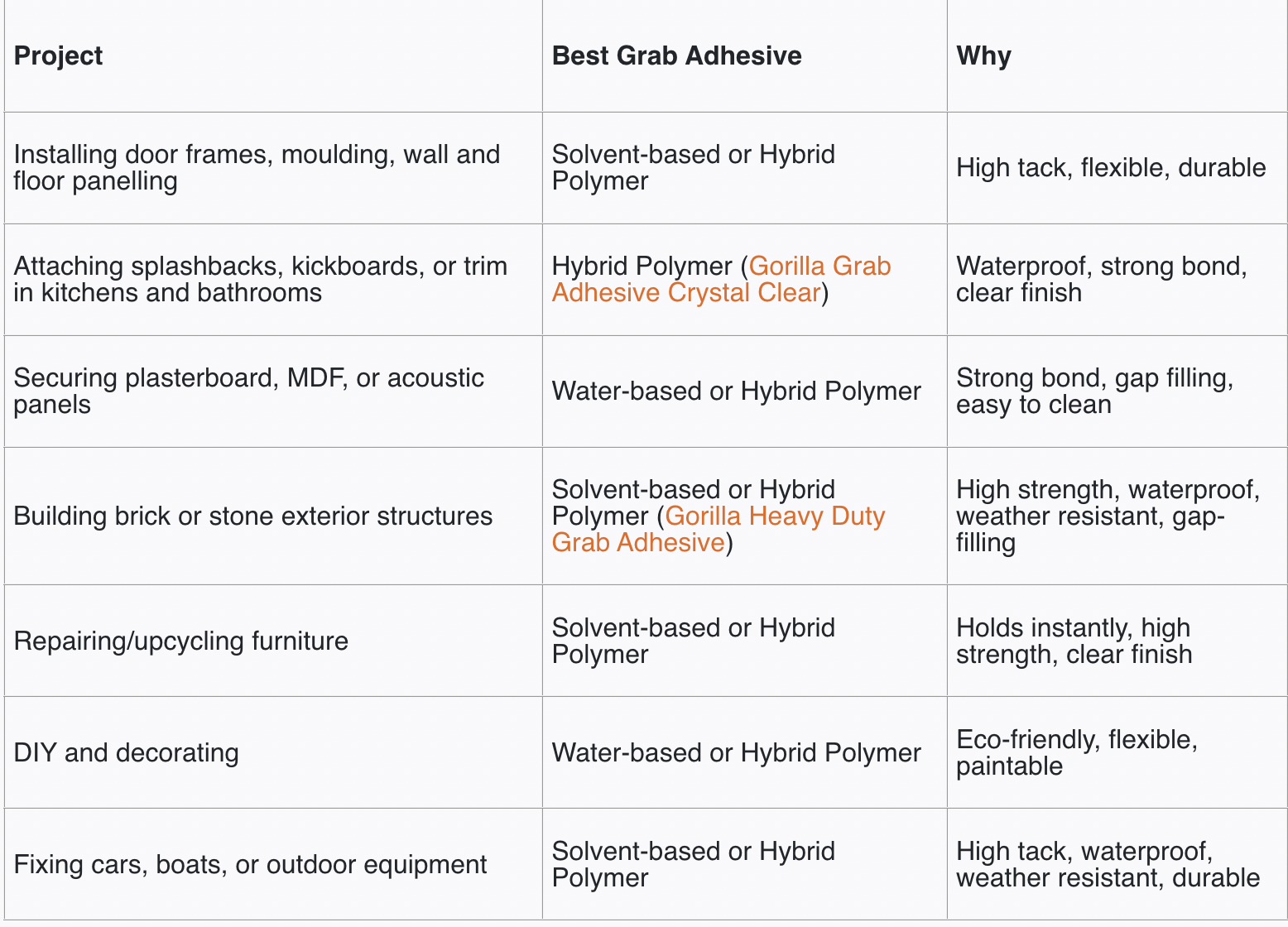
Different Grab Adhesives
Generally speaking, there are three main types of grab adhesives, each with its own properties and uses.
Solvent-Based Adhesives
Solvent-based grab adhesives contain solvents that evaporate when applied, creating a strong, durable bond. They boast high initial tack and are ideal for bonding porous and non-porous substrates like metal and glass.
Drawbacks: Due to their solvent content, they have a strong chemical odour, so proper ventilation is required when used indoors. They also tend to become brittle over time.
Water-Based (Acrylic) Adhesives
Water-based grab adhesives use water to carry and activate acrylic polymers, the key ingredients that create a strong bond once the water evaporates. When the adhesive is applied, the water evaporates, allowing the acrylic polymers to bond to surfaces.
These adhesives are great for indoor projects. They’re low-odour and form a strong bond on porous surfaces like wood, plaster, and ceramics. Some formulations are also marketed as eco-friendly, but users should refer to product-specific certifications or claims.
Drawbacks: They take longer to cure than solvent-based and hybrid grab adhesives. Moreover, they do not work well in humid or wet areas.
Hybrid Polymer Adhesives
Hybrid polymer adhesives, also known as MS polymer adhesives, are based on silane-modified polymers and have gained popularity over the past decade.
They are newer than traditional solvent-based adhesives and are valued for their versatility and performance in demanding conditions. They cure by reacting to moisture in the air or substrate, creating a strong, highly flexible bond.
Unlike contact adhesives, hybrid polymer adhesives are specifically designed to bond most materials, fill gaps, and work well in all conditions.
Drawbacks: They can be costlier than traditional grab adhesives, and some variants require longer curing times.
When To Use High-Strength Grab Adhesives
High-strength grab adhesives are well suited for demanding and vertical applications, including large, heavy materials that would typically require nails, screws, or brackets.
However, users should always refer to the product’s technical datasheet to ensure suitability for safety-critical or high-load installations.
General Tips and Precautions
Here are a few considerations to keep in mind:
1. Choose the Right Adhesive
- Match the adhesive to the task. Consider the material, surface type, weight, and environment.
- Check technical datasheets. Especially important for high-load or safety-critical applications.
2. Surface Preparation
- Clean thoroughly. Remove dust, dirt, oil, or grease from both surfaces.
- Dry completely. Moisture can compromise adhesion, especially with water-based formulas.
3. Application Technique
- Use a cartridge gun. Ensures even application and reduces waste.
- Choose the right nozzle width. Adjust the width for fine lines or larger beads, depending on the surface area.
- Apply in a zig-zag pattern..
- Press the surfaces together firmly. Apply pressure evenly to create a strong initial tack.
4. Curing and Storage
- Let it cure fully. Follow product guidance before applying stress or weight.
- Storage. Store in a cool, dry place to preserve the adhesive’s shelf life.
Troubleshooting Common Issues
Problem: The adhesive is not adhering properly outdoors
Solution: Water-based grab adhesives do not work well in cold, damp, or humid conditions. Make sure the adhesive is temperature- and weather-resistant, such as Gorilla’s range of adhesives. Follow the manufacturer’s instructions for the correct temperature and cure time.
Problem: The bonded item is moving or falling
Solution: Press the surfaces together firmly after application. For heavier objects or vertical applications, you may need to use temporary supports until the adhesive has cured.
Problem: The adhesive is slow to cure or doesn’t cure completely
Solution: Some grab adhesives require moisture or air to cure properly. If you’re using a hybrid grab adhesive, make sure that at least one substrate is porous or exposed to air.
Make Sure You Grab the Right Adhesive
Gorilla’s versatile adhesives are made for clean finishes, strong bonds, and fast fixes, so you can get the job done right the first time. Whether you’re mounting shelves, upgrading a room, or tackling outdoor repairs, there’s a Gorilla product that will get the job done.
Explore our full range of Grab Adhesives to find the right solution for your next project. For more tips, DIY ideas, and guides, be sure to visit the Gorilla Glue Blog.
Information provided within this content is for informational and consideration purposes only.

For the toughest jobs on planet Earth®